
Drone battery voltage is one of the most important specifications when designing or selecting a UAV battery.
The battery voltage affects the electrical system, motor and ESC selection, current requirements, wiring, connectors, power output, and overall aircraft design.
Industrial UAVs can use different battery configurations depending on their size, motor system, payload, mission requirements, and electrical architecture.
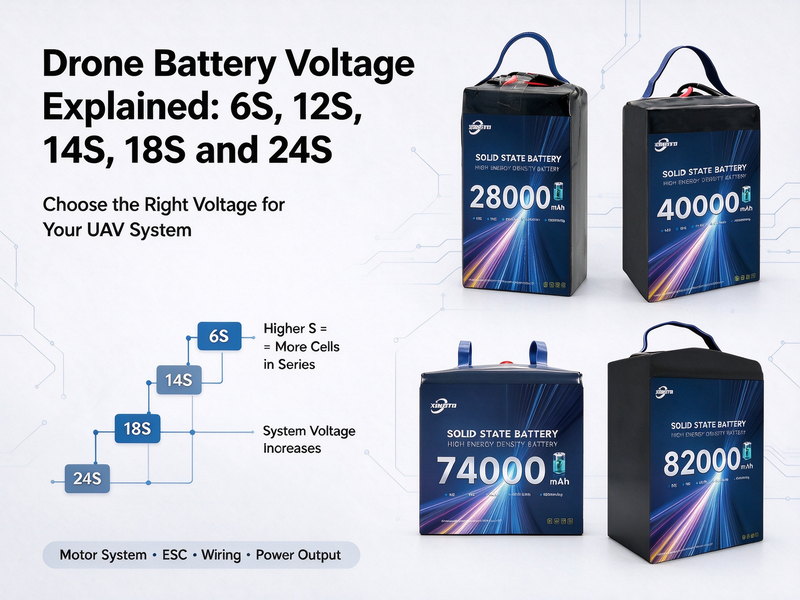
Common configurations include 6S, 12S, 14S, 18S and 24S.
But what do these numbers actually mean?
More importantly, does a higher S rating automatically mean a better drone battery?
The answer is no.
The correct voltage depends on the complete UAV power system.
What Does 6S, 12S, 14S, 18S or 24S Mean?
The letter S means the number of battery cells connected in series.
When cells are connected in series, their voltages are added together.
For a typical lithium-based cell with a nominal voltage around 3.7 V, the approximate nominal pack voltage can be calculated as:
Nominal Voltage = Number of Cells in Series × Nominal Cell Voltage
For example:
6S ≈ 6 × 3.7 V = 22.2 V
12S ≈ 12 × 3.7 V = 44.4 V
14S ≈ 14 × 3.7 V = 51.8 V
18S ≈ 18 × 3.7 V = 66.6 V
24S ≈ 24 × 3.7 V = 88.8 V
The actual maximum charging voltage is higher than the nominal voltage, depending on the specific cell chemistry and manufacturer specification.
This distinction is important when designing a UAV electrical system.
Drone Battery Voltage Chart
| Battery Configuration | Approx. Nominal Voltage | Typical Design Consideration |
|---|---|---|
| 6S | 22.2 V | Smaller and medium UAV systems |
| 12S | 44.4 V | Industrial multirotors and larger UAVs |
| 14S | 51.8 V | Higher-power UAV platforms |
| 18S | 66.6 V | Large industrial UAV systems |
| 24S | 88.8 V | High-power and heavy-duty UAV platforms |
These values are nominal examples. The actual operating voltage range depends on the selected cells, battery configuration, charging limits, and UAV electrical system.
Why Is Drone Battery Voltage Important?
Battery voltage directly affects the relationship between power and current.
The basic electrical relationship is:
Power (W) = Voltage (V) × Current (A)
Therefore:
Current (A) = Power (W) ÷ Voltage (V)
This means that, for the same power requirement, increasing voltage can reduce the current required.
For example, consider a hypothetical UAV requiring 10,000 W.
At 50 V:
10,000 W ÷ 50 V = 200 A
At 100 V:
10,000 W ÷ 100 V = 100 A
The higher-voltage system requires approximately half the current for the same power.
This can have important implications for cables, connectors, electrical losses, and thermal management.
How Does Higher Voltage Affect a Drone?
Higher voltage does not automatically make a UAV more powerful.
Instead, it changes how the electrical system delivers the required power.
A higher-voltage architecture can allow the same power level to be delivered at lower current.
This can potentially help with:
- Cable sizing
- Connector selection
- Electrical losses
- Heat generation
- Power-system efficiency
- Motor and ESC architecture
However, the entire electrical system must be designed for the selected voltage.
6S Drone Battery
A 6S battery contains six cells connected in series.
A typical nominal voltage is approximately:
22.2 V
6S systems are common in many smaller and medium-sized UAV platforms.
They can be suitable for applications where the required power and system architecture fit within the voltage range.
However, the suitability of 6S depends on the motor, ESC, propeller, aircraft weight, and target performance.
12S Drone Battery
A 12S battery contains twelve cells connected in series.
Typical nominal voltage:
44.4 V
12S is widely relevant to industrial UAV power systems because it provides a higher system voltage than 6S while remaining practical for many multirotor architectures.
Industrial applications can include:
- Agricultural UAVs
- Mapping drones
- Inspection drones
- Industrial multirotors
- Long-endurance platforms
- Heavy-payload UAVs
For larger UAVs, 12S can help reduce current requirements compared with lower-voltage configurations at the same power level.
14S Drone Battery
A 14S battery has fourteen cells in series.
Typical nominal voltage:
51.8 V
14S can be useful for UAV systems that require higher voltage but are not designed around the larger voltage levels of 18S or 24S.
For an OEM drone manufacturer, the decision to use 14S should be based on the actual motor and ESC specifications rather than simply selecting a higher voltage because it appears more powerful.
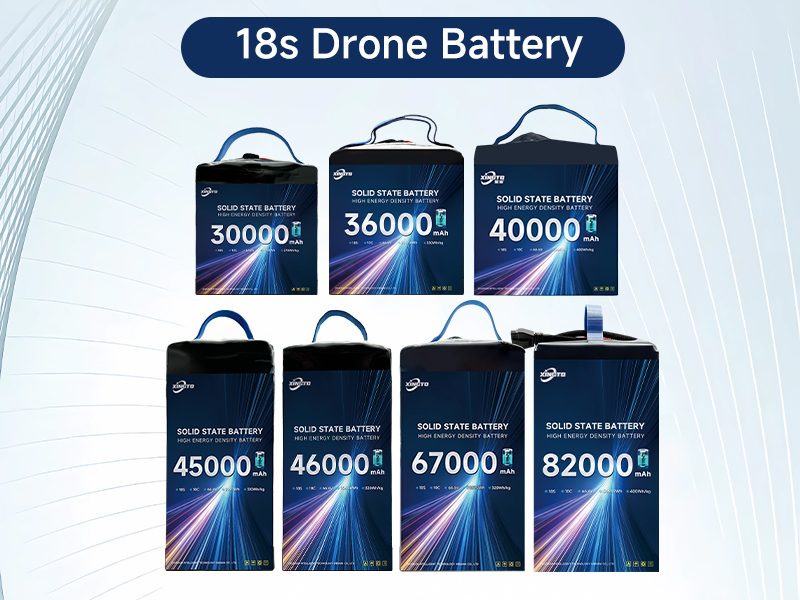
18S Drone Battery
An 18S battery has eighteen cells connected in series.
Typical nominal voltage:
66.6 V
18S systems can be considered for larger industrial UAVs where power requirements are significantly higher.
Potential applications include:
- Heavy-lift UAVs
- Industrial logistics drones
- Large agricultural UAVs
- Specialized inspection platforms
- Long-endurance industrial multirotors
At higher voltage levels, system-level electrical design becomes increasingly important.
Motor compatibility, ESC voltage rating, insulation, connectors, wiring, BMS design, and charging equipment all need to be considered.
24S Drone Battery
A 24S battery contains twenty-four cells in series.
Typical nominal voltage:
88.8 V
24S systems can support high-power UAV architectures where the aircraft requires substantial electrical power.
However, higher voltage also increases the importance of electrical safety and system engineering.
The battery, BMS, ESC, charger, connectors, wiring, and protection system must all be compatible with the actual operating voltage.
Does Higher Voltage Mean Longer Flight Time?
Not necessarily.
Voltage alone does not determine flight time.
Flight endurance is primarily related to available usable energy and the aircraft's average power consumption.
A simplified relationship is:
Flight Time ≈ Usable Battery Energy ÷ Average Power Consumption
Battery energy can be estimated from:
Energy (Wh) = Voltage (V) × Capacity (Ah)
Therefore, comparing only the voltage or only the mAh rating can produce misleading conclusions. A proper comparison should consider the complete energy value in Wh. txshengya.com
Voltage vs Capacity: What Is the Difference?
Voltage and capacity describe different characteristics.
Voltage
Voltage describes the electrical potential of the battery system.
It is measured in volts.
Capacity
Capacity describes how much electrical charge the battery can store.
It is usually expressed in Ah or mAh.
For example:
44.4 V × 30 Ah = 1,332 Wh
A 44.4 V 30 Ah battery therefore has approximately 1,332 Wh of nominal energy.
This is why two batteries with the same Ah rating can contain different amounts of energy if their voltage is different.
Why mAh Alone Is Not Enough
Many drone batteries are marketed using mAh.
For example:
30,000 mAh
But this number does not tell you the complete energy content unless voltage is also known.
30,000 mAh = 30 Ah.
A 6S battery at approximately 22.2 V:
22.2 × 30 = 666 Wh
A 12S battery at approximately 44.4 V:
44.4 × 30 = 1,332 Wh
Both batteries have the same 30 Ah capacity, but the nominal energy is approximately twice as high in the 12S configuration.
Therefore, when comparing industrial UAV batteries, buyers should look at Wh as well as Ah or mAh.
How to Choose the Right Voltage for an Industrial Drone
Selecting the right battery voltage should start with the UAV's electrical system.
Check the Motor Specification
The motor must be compatible with the selected battery voltage.
Motor KV, propeller size, current, and operating voltage all influence the appropriate battery configuration.
Check the ESC Voltage Rating
The ESC must support the maximum voltage of the battery.
This is especially important for high-voltage systems because the fully charged battery voltage is higher than nominal voltage.
Check the Required Power
Determine the UAV's maximum and continuous power requirements.
Then calculate the corresponding current:
Current = Power ÷ Voltage
This helps determine whether a higher-voltage architecture could reduce current requirements.
Check the Battery Weight
A higher-voltage battery may require more cells and potentially different packaging.
The complete battery weight should therefore be evaluated together with the required energy.
Check the Battery Compartment
The battery must physically fit inside the aircraft.
Dimensions, connector location, mounting method, and cable routing can be just as important as electrical specifications.
High Voltage vs High Capacity Drone Batteries
These concepts are often confused.
A higher-voltage battery is not necessarily a higher-capacity battery.
For example:
50 V × 20 Ah = 1,000 Wh
while:
25 V × 40 Ah = 1,000 Wh
Both batteries theoretically contain the same nominal energy.
However, their electrical architecture is different.
The motors, ESCs, wiring, connectors, and control system may be completely different.
Why Industrial UAV Manufacturers Often Need Customized Voltage
Standard batteries may not fit every UAV platform.
An OEM manufacturer may need a battery with a specific:
- Voltage
- Capacity
- Series configuration
- Discharge rate
- Connector
- Dimensions
- Weight
- BMS
- Communication protocol
- Charging method
For this reason, industrial drone battery manufacturers often provide customized battery configurations rather than offering only fixed consumer battery models.
How Xingto Battery Supports Customized UAV Voltage
Xingto Battery focuses on industrial UAV battery applications and can develop battery configurations according to the requirements of different UAV platforms.
For an OEM project, voltage selection should be based on the complete power system rather than choosing a battery from a catalog based on voltage alone.
A manufacturer can evaluate the UAV's:
- Motor and ESC specifications
- Required power
- Target flight time
- Battery capacity
- Maximum current
- Battery compartment
- Connector
- BMS requirements
This approach is especially useful when developing industrial drones with customized power systems.
Frequently Asked Questions
What does 6S mean on a drone battery?
6S means that six battery cells are connected in series. For a typical lithium cell with approximately 3.7 V nominal voltage, a 6S pack has approximately 22.2 V nominal voltage.
What voltage is a 12S drone battery?
A typical 12S lithium battery has approximately 44.4 V nominal voltage.
What voltage is a 14S drone battery?
A typical 14S battery has approximately 51.8 V nominal voltage.
What voltage is an 18S drone battery?
A typical 18S battery has approximately 66.6 V nominal voltage.
What voltage is a 24S drone battery?
A typical 24S battery has approximately 88.8 V nominal voltage.
Is 12S better than 6S for a drone?
Not necessarily. The correct voltage depends on the motor, ESC, power requirement, aircraft weight, battery configuration, and overall electrical architecture.
Does higher voltage increase drone flight time?
Not by itself. Flight time depends primarily on usable energy and average power consumption. Higher voltage can, however, reduce the current required for a given power level.
How do I choose the correct drone battery voltage?
Start with the motor and ESC specifications, then determine the aircraft's power requirements, capacity target, battery weight, dimensions, and mission requirements.
Final Takeaway
Drone battery voltage is a fundamental part of UAV power-system design.
6S, 12S, 14S, 18S and 24S describe the number of cells connected in series and therefore the nominal voltage of the battery pack.
Higher voltage can reduce current requirements for a given power output, but it does not automatically mean better performance or longer flight time.
For industrial UAVs, the best battery voltage is the one that works correctly with the motor, ESC, power system, battery capacity, aircraft weight, and mission requirements.
Developing an industrial UAV that requires a customized battery voltage?
Contact Xingto Battery with your motor, ESC, voltage, capacity, current, and flight-time requirements. Our team can help evaluate a suitable industrial UAV battery configuration.