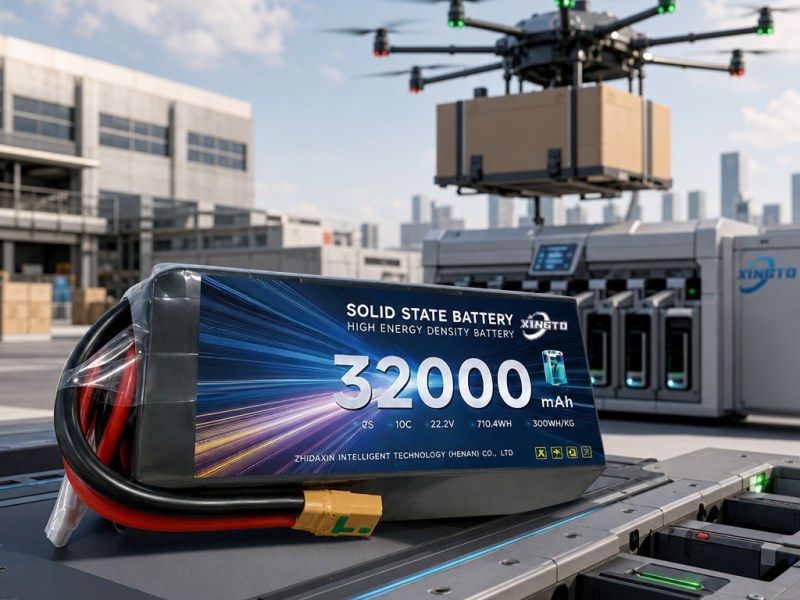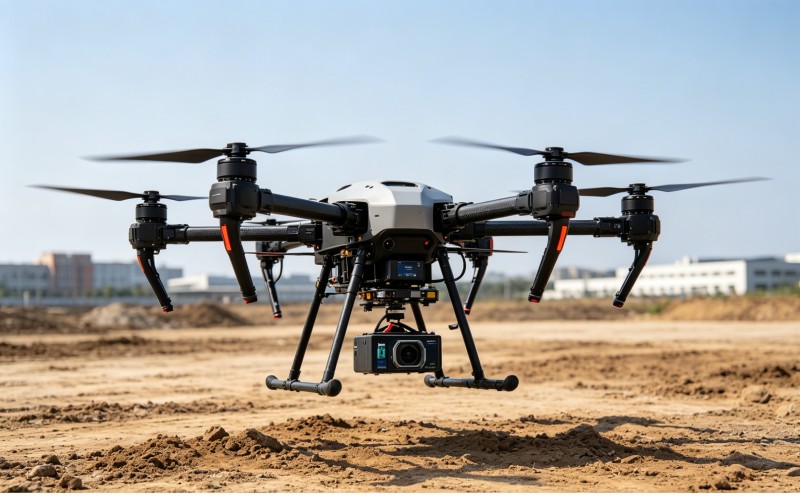

Choosing the right battery capacity is one of the most important decisions in industrial UAV design.
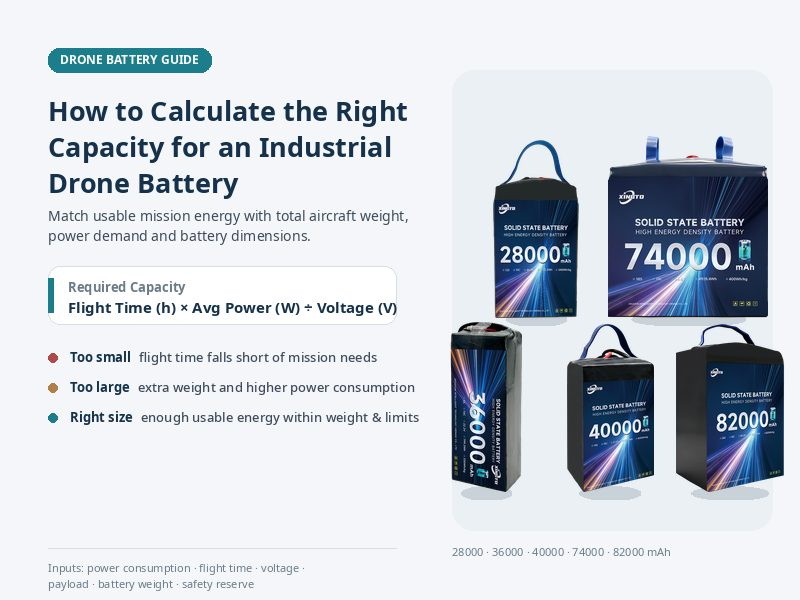
If the capacity is too small, the drone may not achieve the required flight time.
If the capacity is too large, the battery may add unnecessary weight and increase power consumption.
The objective is not simply to choose the largest battery available.
The objective is to find the battery capacity that provides enough usable energy for the mission while keeping the total aircraft weight, power demand, and battery dimensions within acceptable limits.
A practical battery-sizing process starts with the UAV's power consumption, target flight time, voltage, payload, battery weight, and required safety reserve.
What Does Drone Battery Capacity Mean?
Battery capacity describes how much electrical charge a battery can store.
It is commonly expressed in:
- Ah
- mAh
For example:
20 Ah = 20,000 mAh
However, capacity in Ah does not tell you the complete energy stored in the battery.
To calculate energy, voltage must also be considered.
The basic formula is:
Energy (Wh) = Voltage (V) × Capacity (Ah)
Therefore, a 40 Ah battery at 50 V contains approximately:
50 × 40 = 2,000 Wh
This is why industrial UAV battery selection should consider Wh as well as Ah or mAh. txshengya.com
Why Choosing Battery Capacity Is More Complicated for Industrial UAVs
Consumer drones often use relatively standardized batteries.
Industrial UAVs are different.
They can have significantly different:
- Aircraft weights
- Payloads
- Motor configurations
- Propeller sizes
- Flight profiles
- Mission durations
- Voltage systems
- Battery compartments
- Power requirements
An agricultural spray drone may need a very different battery from a mapping UAV.
A heavy-lift cargo drone may require a completely different configuration from a long-endurance inspection drone.
Therefore, battery capacity should be calculated from the aircraft's actual requirements.
The Basic Formula for Required Battery Capacity
If the UAV's average current is known:
Required Capacity (Ah) = Average Current (A) × Flight Time (hours) ÷ Usable Capacity Factor
For example:
Average current = 50 A
Target flight time = 30 minutes
30 minutes = 0.5 hours
Assume an illustrative usable-capacity factor of 0.8:
50 × 0.5 ÷ 0.8 = 31.25 Ah
The calculated battery capacity would therefore be approximately:
31.25 Ah
This is a starting point rather than a final production specification.
The appropriate reserve and usable-energy assumption should be determined according to the battery, UAV, operating procedure, and mission requirements. Different engineering sources use different planning assumptions, which is why a single universal reserve percentage should not be treated as a rule for every UAV.
Capacity Calculation Using Power Consumption
For industrial UAVs, power-based calculation can often be more useful.
The formula is:
Required Energy (Wh) = Average Power (W) × Flight Time (hours)
Then:
Required Battery Energy = Required Mission Energy ÷ Usable Energy Factor
For example:
Average power = 3,000 W
Target flight time = 30 minutes
30 minutes = 0.5 hours
Required mission energy:
3,000 × 0.5 = 1,500 Wh
If the planned usable-energy factor is 0.8:
1,500 ÷ 0.8 = 1,875 Wh
The battery therefore needs approximately 1,875 Wh of nominal energy under this illustrative assumption.
Convert Required Energy to Battery Capacity
Once the required energy is known, convert Wh to Ah.
The formula is:
Capacity (Ah) = Energy (Wh) ÷ Voltage (V)
Suppose:
Required battery energy = 1,875 Wh
Battery voltage = 44.4 V
Required capacity:
1,875 ÷ 44.4 ≈ 42.2 Ah
The initial battery specification could therefore be approximately:
44.4 V, 42 Ah
The final specification would still need to be validated against battery weight, discharge requirements, physical dimensions, and actual flight testing.
Why Voltage Changes the Required Capacity
The same energy can be stored using different combinations of voltage and capacity.
For example:
50 V × 20 Ah = 1,000 Wh
while:
100 V × 10 Ah = 1,000 Wh
Both systems have the same nominal energy.
But their electrical architectures are different.
This is why battery capacity should never be selected without considering system voltage.
mAh vs Ah vs Wh
These three units are frequently confused.
mAh
Milliamp-hours.
1,000 mAh = 1 Ah
Ah
Amp-hours.
Used to describe battery charge capacity.
Wh
Watt-hours.
Used to describe energy.
The relationship is:
Wh = V × Ah
For example:
44.4 V × 30 Ah = 1,332 Wh
Therefore:
30,000 mAh = 30 Ah
but the energy depends on the battery voltage.
How Payload Changes Battery Capacity Requirements
Payload is critical when sizing industrial UAV batteries.
Consider a delivery drone.
Without cargo:
Aircraft weight = 15 kg
With cargo:
Aircraft weight = 20 kg
The propulsion system must generate more lift with the 20 kg configuration.
This can increase power consumption.
Therefore, battery capacity should be calculated based on the actual mission condition, not just the empty-aircraft weight.
Agricultural Drone Battery Capacity
Agricultural UAVs can have particularly demanding battery requirements.
A spraying mission may include:
- Aircraft weight
- Battery weight
- Liquid payload
- Pump system
- Spray equipment
- Sensors
- Flight electronics
As the payload changes during the mission, the aircraft's weight also changes.
For this reason, battery sizing should consider the mission's actual operating conditions.
A battery that works well for an empty test flight may not provide the required endurance under full payload.
Heavy-Lift Drone Battery Capacity
Heavy-lift UAVs require a different battery-sizing approach.
The battery must provide:
- Sufficient energy
- High continuous current
- Adequate peak current
- Suitable voltage
- Acceptable weight
- Appropriate thermal performance
Simply increasing capacity may not solve the problem.
If the additional battery capacity adds too much weight, the aircraft may require substantially more power.
This can reduce the expected endurance gain.
Long-Endurance Drone Battery Capacity
For long-endurance UAVs, energy density becomes especially important.
Suppose two batteries provide the same nominal energy.
Battery A:
2,000 Wh / 10 kg = 200 Wh/kg
Battery B:
2,000 Wh / 8 kg = 250 Wh/kg
Battery B provides the same nominal energy at a lower weight.
The 2 kg difference may allow greater payload flexibility or reduce the aircraft's overall power demand.
This is one reason why industrial UAV battery development increasingly focuses on energy density as well as capacity.
How Battery Weight Affects Capacity Selection
There is a practical limit to how large the battery should be.
A larger battery can provide more energy.
But a larger battery also adds mass.
Additional mass increases the lift required from the propulsion system.
Therefore, battery capacity and battery weight should be optimized together.
This creates an iterative design process:
More capacity → more energy → more weight → more power demand → potentially less endurance gain
The best capacity is therefore not necessarily the largest capacity.
How to Choose the Right Battery Capacity Step by Step
Step 1: Determine the Target Flight Time
Start with the mission requirement.
For example:
Target endurance = 30 minutes
Step 2: Determine Average Power
Use measured flight data whenever possible.
For example:
Average power = 2,500 W
Step 3: Calculate Mission Energy
30 minutes = 0.5 hours
2,500 × 0.5 = 1,250 Wh
Step 4: Add an Appropriate Energy Reserve
Suppose the engineering plan uses an illustrative usable-energy factor of 0.8.
1,250 ÷ 0.8 = 1,562.5 Wh
Step 5: Select the System Voltage
Suppose the UAV uses approximately:
44.4 V
Step 6: Calculate Required Capacity
1,562.5 ÷ 44.4 ≈ 35.2 Ah
The preliminary battery specification would therefore be around:
44.4 V / 35 Ah
Step 7: Check Battery Weight
Now check whether the battery weight is acceptable for the aircraft.
If the battery is too heavy, increasing capacity may not produce the expected endurance improvement.
Step 8: Check Discharge Requirements
Calculate the maximum current.
For example, if the UAV can require 250 A:
250 A ÷ 35 Ah ≈ 7.1C
The selected battery must support the required continuous and peak current.
Step 9: Check Physical Dimensions
The battery must fit inside the aircraft.
Check:
- Length
- Width
- Height
- Connector location
- Cable routing
- Mounting method
Step 10: Validate Through Flight Testing
The final battery should be validated under realistic mission conditions.
Why Battery Capacity Should Not Be Selected From mAh Alone
Suppose a supplier offers:
30,000 mAh
That number alone is not enough.
You also need to know:
- Voltage
- Weight
- Energy
- C rating
- Dimensions
- Chemistry
- BMS
- Connector
A 30,000 mAh battery can have very different energy depending on voltage.
This is especially important when comparing different UAV battery suppliers.
Battery Capacity and C Rate
Capacity also influences current capability.
The simplified relationship is:
Current = Capacity × C Rate
For example:
30 Ah × 10C = 300 A
A larger capacity battery can therefore provide more current at the same C rating.
However, actual continuous and peak current capability should always be confirmed from the battery manufacturer's technical specification.
Battery Capacity and Energy Density
Energy density is another important factor.
The formula is:
Energy Density = Battery Energy ÷ Battery Weight
Suppose:
Battery energy = 2,000 Wh
Battery weight = 8 kg
Then:
2,000 ÷ 8 = 250 Wh/kg
A higher-energy-density battery may allow the UAV manufacturer to achieve a target energy level with less weight.
For industrial UAVs, this can be particularly valuable when both endurance and payload are important.
How Semi-Solid-State Batteries Can Affect UAV Battery Sizing
Semi-solid-state battery technology is attracting attention in industrial UAV applications because battery weight is one of the most important constraints in aircraft design.
If a battery system can provide higher energy density, an aircraft manufacturer may have more flexibility to balance:
- Flight time
- Battery weight
- Payload
- Battery volume
- Power requirements
However, the actual result depends on the specific battery design and aircraft.
Battery capacity should therefore always be evaluated at the complete pack level, not based only on individual cell specifications.
Why Pack-Level Specifications Matter
A complete UAV battery includes more than cells.
It may include:
- Cells
- BMS
- Cables
- Connectors
- Housing
- Busbars
- Insulation
- Protection components
All of these contribute to the total battery weight and volume.
Therefore, when comparing suppliers, ask for the complete battery:
Voltage + Capacity + Energy + Weight + Dimensions + Current Capability
This gives you a much more useful basis for comparison.
How Xingto Battery Can Help With Industrial UAV Battery Sizing
Xingto Battery focuses on industrial UAV battery applications and customized battery configurations.
For an OEM project, battery capacity can be evaluated according to the UAV's actual requirements rather than selecting a standard battery simply because it has a large mAh number.
Useful information includes:
- UAV takeoff weight
- Payload
- Target flight time
- Average power
- Maximum current
- Motor specification
- ESC specification
- Required voltage
- Battery compartment
- Connector
- Charging requirements
Based on these parameters, the battery configuration can be evaluated around the required energy, weight, discharge performance, and dimensions.
Frequently Asked Questions
How do I calculate the capacity of a drone battery?
A basic method is:
Required Capacity (Ah) = Average Current (A) × Flight Time (hours) ÷ Usable Capacity Factor
If power is known:
Required Energy (Wh) = Average Power (W) × Flight Time (hours)
Then convert Wh to Ah using:
Ah = Wh ÷ Voltage
How many mAh does an industrial drone need?
There is no universal mAh requirement. Capacity depends on the drone's voltage, power consumption, flight time, payload, battery weight, and mission profile.
Is a higher mAh battery always better?
No. A higher-capacity battery generally stores more energy but may also weigh more. Excessive battery weight can increase power consumption.
How do I convert drone battery mAh to Wh?
First convert mAh to Ah:
Ah = mAh ÷ 1,000
Then:
Wh = Voltage × Ah
How much battery capacity do I need for 30 minutes of flight?
It depends on average power consumption.
For example, a UAV consuming 2,000 W for 30 minutes requires approximately:
2,000 × 0.5 = 1,000 Wh
of mission energy before applying the appropriate reserve and usable-energy assumptions.
Should I choose battery capacity based on flight time or payload?
Both matter. Target flight time determines required energy, while payload affects aircraft weight and therefore power consumption.
Why does my larger battery not provide proportionally longer flight time?
Because a larger battery adds weight. The additional weight can increase propulsion power consumption, reducing the net endurance benefit.
Final Takeaway
Choosing the right industrial drone battery capacity is an optimization problem rather than a simple search for the largest mAh rating.
A practical sizing process should consider:
- Target flight time
- Average power consumption
- Battery voltage
- Required energy
- Usable energy
- Battery weight
- Payload
- C rate
- Dimensions
- Thermal performance
- Mission conditions
The basic relationship is:
Energy (Wh) = Voltage (V) × Capacity (Ah)
and:
Flight Time ≈ Usable Energy ÷ Average Power
For industrial UAV development, these calculations should be followed by actual bench and flight testing.
Need help calculating the right battery capacity for your industrial UAV?
Send Xingto Battery your target flight time, UAV weight, payload, motor power, voltage, maximum current, and battery dimensions. We can help evaluate a suitable battery capacity and configuration for your UAV project.