
Drone flight time is one of the first specifications that UAV manufacturers, operators, and buyers want to know.
But calculating realistic flight time is more complicated than simply looking at the battery's mAh rating.
A drone's endurance depends on the relationship between usable battery energy and the aircraft's average power consumption.
A useful starting formula is:
Flight Time (hours) ≈ Usable Battery Energy (Wh) ÷ Average Power Consumption (W)
To convert hours into minutes:
Flight Time (minutes) ≈ Usable Battery Energy (Wh) ÷ Average Power Consumption (W) × 60
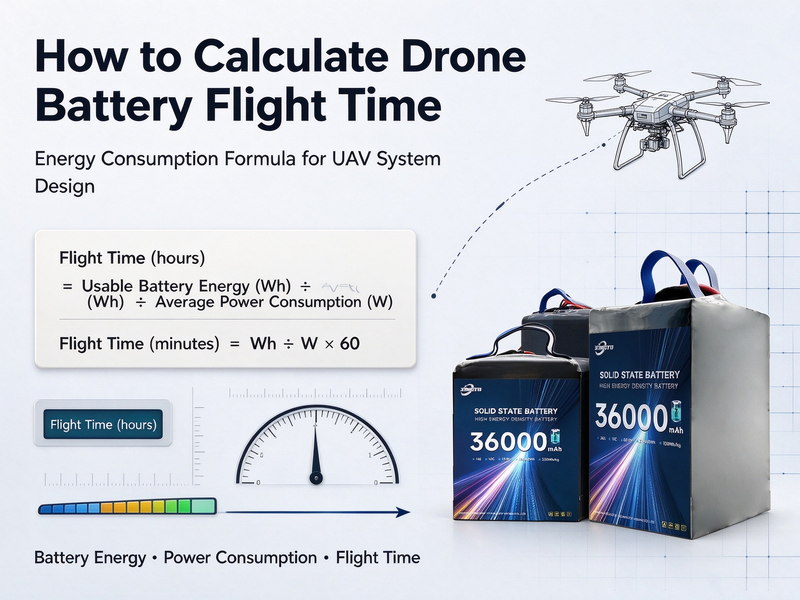
This is a useful engineering starting point, but actual flight time will vary with aircraft weight, payload, flight mode, wind, temperature, battery condition, and other operating factors. Recent UAV engineering guides also emphasize using measured battery and power data rather than relying only on nameplate specifications.
What Determines Drone Flight Time?
Several variables affect UAV endurance.
The most important include:
- Battery energy
- Battery weight
- Average power consumption
- Aircraft weight
- Payload
- Motor and propeller efficiency
- Flight mode
- Wind
- Temperature
- Battery condition
- Landing reserve
- Mission profile
This means that installing a larger battery does not automatically produce a proportional increase in flight time.
A larger battery stores more energy, but it also adds weight.
That additional weight requires more thrust and can increase power consumption.
The Basic Drone Flight Time Formula
The simplest energy-based formula is:
Flight Time (hours) = Usable Battery Energy (Wh) ÷ Average Power (W)
Then:
Flight Time (minutes) = Flight Time (hours) × 60
For example, assume:
Battery energy = 1,000 Wh
Average power consumption = 2,500 W
Theoretical flight time:
1,000 ÷ 2,500 = 0.4 hours
Convert to minutes:
0.4 × 60 = 24 minutes
This is a simplified calculation.
In actual operation, the battery may not provide all 1,000 Wh as usable mission energy.
How to Calculate Battery Energy in Wh
Battery energy can be estimated using:
Energy (Wh) = Voltage (V) × Capacity (Ah)
If the battery is specified in mAh:
Capacity (Ah) = Capacity (mAh) ÷ 1,000
For example:
Battery voltage = 44.4 V
Capacity = 30,000 mAh
First:
30,000 mAh ÷ 1,000 = 30 Ah
Then:
44.4 V × 30 Ah = 1,332 Wh
The nominal battery energy is therefore approximately 1,332 Wh.
This is why Wh is often more useful than mAh when comparing batteries with different voltage configurations.
Rated Energy vs Usable Energy
One of the biggest mistakes in flight-time calculations is treating the full rated battery energy as available for the entire mission.
A UAV normally needs a reserve.
The usable energy depends on:
- Battery chemistry
- Battery condition
- Manufacturer recommendations
- Current load
- Operating temperature
- Voltage behavior
- BMS settings
- Mission safety requirements
Therefore:
Usable Energy < Rated Energy
For example, if a battery has 1,000 Wh of nominal energy and the mission plan uses 80% of the rated energy:
1,000 × 0.80 = 800 Wh
The calculation should then use approximately 800 Wh rather than 1,000 Wh.
The exact reserve should be determined according to the battery and aircraft operating requirements rather than assuming one universal percentage.
How to Calculate Flight Time Using Battery Capacity and Current
If the average current draw is known instead of power consumption, another useful formula is:
Flight Time (hours) ≈ Usable Capacity (Ah) ÷ Average Current (A)
Then:
Flight Time (minutes) ≈ Usable Capacity (Ah) ÷ Average Current (A) × 60
For example:
Battery capacity = 30 Ah
Usable capacity = 24 Ah
Average current = 60 A
Estimated flight time:
24 ÷ 60 = 0.4 hours
or:
24 minutes
This approach can be particularly useful when UAV telemetry provides average battery current.
How to Calculate Average Power Consumption
Power is calculated using:
Power (W) = Voltage (V) × Current (A)
For example:
Voltage = 44.4 V
Average current = 60 A
Average power:
44.4 × 60 = 2,664 W
If the battery provides approximately 1,332 Wh nominal energy:
1,332 ÷ 2,664 × 60 ≈ 30 minutes
Again, actual mission time will be lower or different depending on usable energy and operating conditions.
Why Drone Flight Time Changes During a Mission
A drone does not necessarily consume the same amount of power throughout an entire flight.
Power demand can change during:
- Takeoff
- Hover
- Climbing
- Forward flight
- Turning
- Acceleration
- Payload operation
- Descending
- Landing
For a multirotor, takeoff and climbing can require significantly different power from steady cruise or hover.
Therefore, using a realistic average power consumption is important.
How Payload Affects Flight Time
Payload is one of the most important variables for industrial UAVs.
Suppose an agricultural drone flies with an empty tank.
The aircraft has one weight.
When the tank is filled, the total takeoff weight increases.
The propulsion system must generate additional lift.
This increases power consumption and can reduce flight time.
The same principle applies to:
- Delivery drones
- Firefighting drones
- Mapping UAVs
- Inspection drones
- Heavy-lift UAVs
- Search and rescue platforms
Why Battery Weight Matters
Battery weight creates an important design trade-off.
Increasing battery capacity generally adds battery mass.
More mass means the drone needs more thrust.
More thrust can require more power.
Therefore, adding battery capacity does not always increase endurance proportionally.
This is one reason why energy density is so important for industrial UAV battery design.
A battery with higher energy density may provide more energy without increasing weight by the same proportion.
Example: Why a Bigger Battery Does Not Always Double Flight Time
Imagine a drone currently uses:
Battery energy: 800 Wh
Average power: 2,000 W
Theoretical endurance:
800 ÷ 2,000 × 60 = 24 minutes
Now suppose a larger battery increases stored energy to 1,200 Wh.
If the battery adds significant weight and the average power consumption increases to 2,400 W:
1,200 ÷ 2,400 × 60 = 30 minutes
The battery energy increased by 50%, but flight time increased by only 25%.
This demonstrates why battery sizing must consider the complete aircraft system.
How Wind Affects Drone Flight Time
Wind can increase the energy required for certain flight profiles.
A headwind can require the aircraft to generate more propulsion power to maintain the required ground speed.
Mission planning should therefore consider actual operating conditions.
A flight-time estimate based on calm indoor testing may not represent field performance.
How Temperature Affects Flight Time
Temperature can affect battery performance.
Cold conditions can increase internal resistance and reduce available performance.
High temperatures can also affect battery life, thermal management, and operating limits.
Therefore, industrial UAV battery testing should consider the temperatures expected during actual missions.
How Battery Aging Affects Flight Time
Battery performance changes as the battery is used.
Factors such as:
- Cycle count
- Charging conditions
- Discharge current
- Temperature
- Storage conditions
can affect battery performance over time.
A flight-time estimate based on a new battery may therefore not represent performance after extended field use.
How to Measure Real Drone Power Consumption
For serious UAV development, measured data is better than assumptions.
Useful sources include:
Flight Controller Telemetry
Many UAV systems record:
- Battery voltage
- Current
- Power
- Battery percentage
- Flight time
These records can help estimate actual energy consumption.
Power Analyzer
A power analyzer can measure electrical consumption during controlled testing.
Bench Testing
A propulsion test stand can help engineers evaluate:
- Motor performance
- Propeller efficiency
- Current
- Voltage
- Thrust
- Power
Post-Flight Battery Data
The amount of energy returned to the battery during charging can also provide useful information about energy consumed during the flight.
This should be interpreted carefully because charger measurements and battery behavior are not perfect representations of aircraft energy use.
A Practical Drone Flight-Time Calculation Example
Consider an industrial UAV with:
Battery: 44.4 V
Capacity: 30 Ah
Nominal energy: 1,332 Wh
Estimated usable energy: 1,066 Wh
Average power consumption: 2,500 W
Calculate:
1,066 ÷ 2,500 × 60 = approximately 25.6 minutes
Therefore, the estimated practical flight time is approximately:
26 minutes
This is more useful than simply calculating:
1,332 ÷ 2,500 × 60 = 32 minutes
because the second result assumes the full nominal battery energy can be used.
How to Improve Drone Flight Time
If a UAV manufacturer wants longer endurance, there are several approaches.
Increase Battery Energy Density
A higher-energy-density battery can potentially provide more energy without adding the same amount of weight.
Reduce Aircraft Weight
Reducing frame, wiring, landing gear, electronics, and other unnecessary mass can improve efficiency.
Optimize Propellers
Propeller selection affects propulsion efficiency.
Improve Motor Efficiency
Efficient motors can reduce power consumption.
Optimize Flight Profile
Aggressive acceleration and unnecessary maneuvering can increase energy consumption.
Reduce Payload When Possible
Payload directly affects aircraft weight and therefore propulsion requirements.
How Xingto Battery Can Support Longer-Endurance UAV Development
Xingto Battery focuses on industrial UAV battery solutions where endurance, battery weight, energy density, power output, and customization need to be considered together.
For an OEM project, the battery should be selected according to the complete aircraft system.
Useful information for battery evaluation includes:
- UAV takeoff weight
- Payload
- Motor specifications
- ESC specifications
- Average current
- Maximum current
- Target flight time
- Battery compartment dimensions
- Required voltage
- Required capacity
- Connector
- Charging requirements
With these parameters, a battery supplier can work backward from the mission requirements to develop a more suitable battery configuration.
Frequently Asked Questions
How do I calculate drone flight time?
A basic formula is:
Flight Time (minutes) ≈ Usable Battery Energy (Wh) ÷ Average Power (W) × 60
How do I calculate drone battery energy?
Use:
Energy (Wh) = Voltage (V) × Capacity (Ah)
Convert mAh to Ah by dividing by 1,000.
Does higher battery capacity always mean longer flight time?
No. A larger battery usually weighs more, which can increase aircraft power consumption. The overall effect depends on battery energy density and aircraft efficiency.
Why is actual flight time shorter than the calculated time?
Common reasons include battery reserve, payload, wind, temperature, battery aging, voltage sag, propulsion efficiency, and differences between rated and actual battery capacity.
What is the most accurate way to calculate drone flight time?
Use measured battery discharge data and realistic average power consumption under the actual aircraft weight, payload, environment, and mission profile. Engineering references recommend validating calculations against real flight or bench data rather than relying only on battery labels.
How can I increase industrial drone flight time?
Typical strategies include improving battery energy density, reducing aircraft weight, optimizing propulsion efficiency, reducing unnecessary payload, and selecting a battery matched to the aircraft's power requirements.
Final Takeaway
Drone flight time is fundamentally a relationship between usable energy and power consumption.
The basic formula is:
Flight Time (minutes) ≈ Usable Battery Energy (Wh) ÷ Average Power (W) × 60
But realistic UAV endurance requires more than simple mathematics.
Battery weight, payload, propulsion efficiency, temperature, wind, battery condition, and operating reserve can all change the final result.
For industrial UAV development, the best approach is to combine theoretical calculations with real battery and flight data.
Need a battery designed around your target UAV flight time?
Contact Xingto Battery with your drone's weight, payload, voltage, average power, maximum current, and target endurance. We can help evaluate the battery capacity and configuration required for your industrial UAV project.