
When choosing a battery for an industrial drone, manufacturers often encounter two important specifications: Wh/kg and Wh/L.
Both describe battery energy density, but they measure different things.
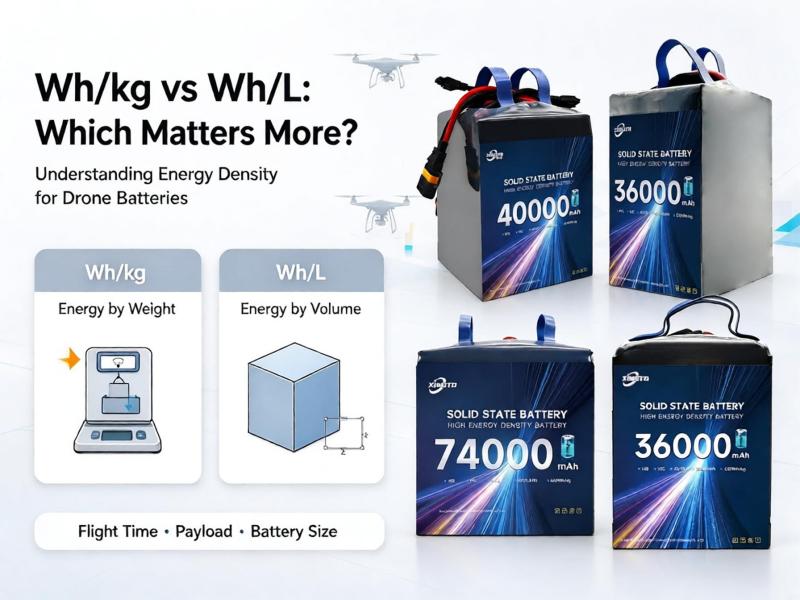
Wh/kg measures energy relative to battery weight.
Wh/L measures energy relative to battery volume.
For many UAV applications, Wh/kg is particularly important because aircraft weight directly affects lift, power consumption, endurance, and payload capacity. However, Wh/L can become equally important when the battery compartment has strict dimensional limitations.
The right choice therefore depends on the aircraft design.
Quick Answer: What Is the Difference Between Wh/kg and Wh/L?
Wh/kg is called gravimetric energy density.
Wh/L is called volumetric energy density.
Wh/kg
Wh/kg = Battery Energy ÷ Battery Weight
It tells you how much energy can be stored per kilogram.
Wh/L
Wh/L = Battery Energy ÷ Battery Volume
It tells you how much energy can be stored within a specific volume.
A simple way to remember the difference is:
Wh/kg = energy efficiency by weight
Wh/L = energy efficiency by space
Why Wh/kg Is Important for UAVs
Weight is one of the biggest constraints in drone design.
A multirotor must continuously generate enough thrust to support its total weight.
That includes:
- Airframe
- Motors
- ESCs
- Propellers
- Flight controller
- Sensors
- Communication equipment
- Payload
- Battery
The battery itself may represent a substantial portion of the aircraft's total weight.
Therefore, reducing battery weight while maintaining the required energy can improve the overall aircraft design.
Higher Wh/kg Can Support Longer Endurance
Consider two hypothetical batteries.
Battery A:
Energy = 1,500 Wh
Weight = 7.5 kg
Energy density:
1,500 ÷ 7.5 = 200 Wh/kg
Battery B:
Energy = 1,500 Wh
Weight = 6 kg
Energy density:
1,500 ÷ 6 = 250 Wh/kg
Both batteries provide the same nominal energy, but Battery B is lighter.
The 1.5 kg difference could potentially be used to reduce aircraft weight or increase payload capacity, depending on the overall design.
Why Wh/L Matters for Drone Batteries
Wh/L becomes important when battery installation space is limited.
Imagine a UAV with a battery compartment measuring:
Length: 300 mm
Width: 150 mm
Height: 100 mm
The available volume is fixed.
Even if a battery has excellent Wh/kg, it may not provide enough energy if its physical volume is too large.
In this case, volumetric energy density becomes an important design parameter.
Drones With Limited Battery Space
Wh/L can be especially relevant for:
- Compact UAVs
- Foldable industrial drones
- VTOL platforms
- Fixed battery-compartment designs
- Aircraft with integrated battery bays
- Drones requiring large payload systems
Wh/kg vs Wh/L for Different UAV Applications
There is no universal winner.
Long-Endurance UAVs
Long-endurance UAVs often place greater emphasis on Wh/kg.
The aircraft may have sufficient physical space for the battery but strict limits on total mass.
Compact Industrial Drones
Compact drones may need to pay more attention to Wh/L because the battery compartment is physically constrained.
Heavy-Lift UAVs
Heavy-lift UAVs need to balance both metrics.
They require enough energy for long missions while also maintaining high power output and acceptable battery weight.
Agricultural Drones
Agricultural drones typically need substantial power because they must support spraying systems and relatively large liquid payloads.
In these systems, battery weight and discharge performance can both be critical.
Which Is More Important: Wh/kg or Wh/L?
For most industrial UAVs, Wh/kg is often the first energy-density metric engineers examine, because aircraft weight has a direct effect on flight performance.
However, that does not mean Wh/L can be ignored.
A practical evaluation should consider both.
A Better UAV Battery Evaluation Method
Instead of asking:
"Does this battery have the highest Wh/kg?"
ask:
"Can this battery provide the required mission energy within our aircraft's weight and space limits?"
This is a much better engineering question.
How to Calculate Both Wh/kg and Wh/L
Suppose a UAV battery has:
Nominal energy: 2,000 Wh
Weight: 8 kg
Volume: 10 L
Calculate Wh/kg
2,000 Wh ÷ 8 kg = 250 Wh/kg
Calculate Wh/L
2,000 Wh ÷ 10 L = 200 Wh/L
The battery therefore has:
250 Wh/kg
and
200 Wh/L
These two values describe different characteristics of exactly the same battery.
Cell-Level vs Pack-Level Energy Density
When comparing suppliers, it is important to determine whether the specification refers to the cell or the finished battery.
Why Cell-Level Data Can Be Misleading
Cells are only one part of a UAV battery.
A complete battery can include:
- Battery cells
- BMS
- Connectors
- Busbars
- Cables
- Housing
- Insulation
- Protection components
All of these add weight and volume.
Therefore, a cell's Wh/kg does not automatically represent the energy density of the finished UAV battery.
Always Ask for Complete Pack Specifications
For procurement and engineering evaluation, request:
- Complete battery weight
- Battery dimensions
- Nominal voltage
- Rated capacity
- Nominal energy
- Continuous discharge current
- Peak discharge current
- Charging specifications
- Operating temperature
- BMS information
You can then calculate the actual pack-level Wh/kg and Wh/L.
Does Higher Wh/kg Mean Better Drone Performance?
Not necessarily.
A battery can have high energy density but insufficient power capability.
Industrial UAVs often operate under high loads, particularly during:
- Takeoff
- Climbing
- Rapid acceleration
- Wind resistance
- Heavy payload operation
A suitable battery must therefore provide both energy and power.
Energy Density vs Power Density
Energy density answers:
How much energy can the battery store?
Power capability answers:
How quickly can the battery deliver that energy?
These are different characteristics.
A long-endurance UAV may prioritize energy density.
A heavy-lift multirotor may require a combination of high energy density and high discharge capability.
How Battery Chemistry Affects Wh/kg and Wh/L
Different battery technologies have different balances between energy density, power capability, safety, cycle life, and thermal behavior.
Traditional lithium polymer batteries are widely used in UAVs because of their high power capability.
Lithium-ion batteries can offer strong energy density characteristics for certain applications.
Semi-solid-state technologies are being developed to increase energy density while addressing the requirements of practical battery systems.
The correct chemistry depends on the UAV mission.
Why Semi-Solid-State Batteries Are Interesting for UAVs
Semi-solid-state battery technology is particularly interesting for industrial drones because UAV designers are constantly looking for more energy without adding excessive weight.
For example, a higher-energy-density battery may allow an aircraft manufacturer to:
- Extend flight time
- Reduce battery weight
- Increase payload flexibility
- Reduce the number of battery swaps
- Improve mission efficiency
The actual improvement depends on the complete aircraft system.
How to Choose Between High Wh/kg and High Wh/L
Use the following approach.
Choose Wh/kg as a Priority When
Your UAV has:
- Strict maximum takeoff weight
- Long endurance requirements
- Large battery capacity requirements
- High payload requirements
- Sufficient physical battery space
Prioritize Wh/L When
Your UAV has:
- Limited battery-compartment space
- Strict battery dimensions
- Compact aircraft architecture
- Integrated battery housing
- High energy requirements within a small volume
Prioritize Both When
You are developing a high-performance industrial UAV where both weight and physical space are constrained.
This is often the case for advanced commercial and professional drone platforms.
How Xingto Battery Can Support Industrial UAV Battery Design
Xingto Battery focuses on industrial UAV battery applications where battery weight, energy, power, dimensions, and system compatibility all need to be considered together.
For an OEM project, battery selection should begin with the UAV's actual requirements rather than selecting a battery based on a single headline specification.
The engineering process can consider:
- Required flight time
- Average power consumption
- Maximum power
- Payload
- Battery compartment
- Voltage
- Capacity
- Discharge rate
- Connector
- Communication requirements
This approach helps determine whether the project should prioritize Wh/kg, Wh/L, or a balance of both.
Frequently Asked Questions
What does Wh/kg mean?
Wh/kg means watt-hours per kilogram. It measures the amount of energy stored relative to battery weight.
What does Wh/L mean?
Wh/L means watt-hours per liter. It measures the amount of energy stored relative to battery volume.
Is Wh/kg more important than Wh/L for drones?
For many UAVs, Wh/kg is especially important because battery weight affects lift and endurance. However, Wh/L can be critical when battery space is limited.
Can a battery have high Wh/kg but low Wh/L?
Yes. Energy density by weight and energy density by volume are independent characteristics. A battery can perform well in one metric without being optimal in the other.
Should I compare cell or pack energy density?
For UAV procurement, pack-level energy density is generally more useful because it reflects the complete battery system installed on the aircraft.
Final Takeaway
Wh/kg and Wh/L answer two different questions.
Wh/kg asks: How much energy can I carry for each kilogram?
Wh/L asks: How much energy can I fit into a specific space?
For industrial drones, Wh/kg is often a critical factor because battery weight directly influences flight performance. However, Wh/L becomes increasingly important when aircraft dimensions and battery compartments are constrained.
The best UAV battery is not simply the battery with the highest number.
It is the battery that delivers the required energy and power while meeting the aircraft's weight, volume, thermal, electrical, and mechanical requirements.
CTA
Need help choosing between high Wh/kg and high Wh/L for your UAV?
Contact Xingto Battery with your drone's voltage, capacity, flight-time target, payload, and battery-compartment dimensions to discuss a suitable industrial UAV battery configuration.