
C rate is one of the most important specifications when selecting a battery for an industrial drone.
It indicates how quickly a battery can theoretically charge or discharge relative to its rated capacity.
For UAV applications, C rate is particularly important because drones can experience high power demands during takeoff, climbing, acceleration, maneuvering, and heavy-payload operation.
Choosing a battery with an inappropriate C rating can result in voltage sag, excessive heating, reduced performance, or even battery damage.
Quick Answer: What Is Battery C Rate?
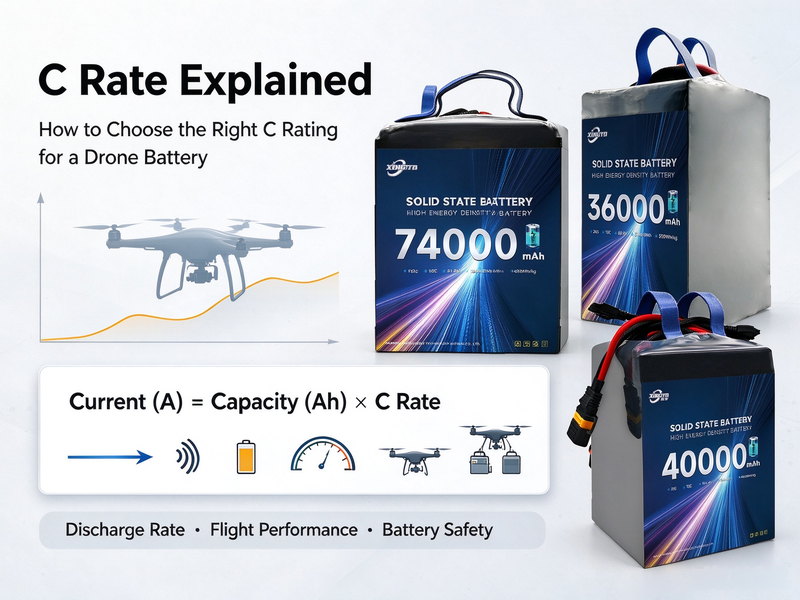
The C rate describes the current relative to a battery's capacity.
A simplified formula is:
Current (A) = Capacity (Ah) × C Rate
For example, a 20 Ah battery rated at 10C has a theoretical continuous discharge current of:
20 Ah × 10C = 200 A
A 20 Ah battery rated at 20C would theoretically provide:
20 Ah × 20C = 400 A
However, the advertised C rating should not be interpreted as a guarantee that the battery can safely operate at that current under every condition.
Actual performance depends on temperature, battery condition, cell characteristics, wiring, connectors, BMS, cooling, and manufacturer specifications.
Why C Rate Matters for Drone Batteries
Industrial drones often have large instantaneous power requirements.
A battery may need to deliver high current during:
- Takeoff
- Climbing
- Heavy payload operation
- Fast acceleration
- Strong wind
- Rapid maneuvering
- Emergency recovery
If the battery cannot provide sufficient current, voltage may drop significantly under load.
What Happens When C Rate Is Too Low?
An underspecified battery may experience:
- Voltage sag
- Excessive heating
- Reduced motor performance
- Lower efficiency
- Shorter flight time
- BMS protection activation
- Reduced battery lifespan
In severe cases, insufficient battery performance can affect flight stability.
How to Calculate the Required C Rate
The basic calculation is:
Required C Rate = Maximum Current ÷ Battery Capacity
Suppose an industrial UAV requires a maximum battery current of 300 A.
The selected battery capacity is 30 Ah.
Required C rate:
300 A ÷ 30 Ah = 10C
The theoretical minimum rating is therefore 10C.
However, selecting a battery exactly at the calculated limit may leave insufficient margin for real-world conditions.
Engineers should consider an appropriate safety and performance margin based on the battery manufacturer's specifications and the aircraft's operating profile.
Continuous C Rate vs Peak C Rate
One of the most important distinctions is between continuous and peak discharge ratings.
Continuous C Rate
Continuous C rate refers to the current a battery is designed to deliver continuously under specified conditions.
This rating is more relevant to sustained UAV operation.
Peak C Rate
Peak C rate refers to a higher current that may be available for a limited period.
It may be relevant during:
- Takeoff
- Short climbs
- Acceleration
- High-load maneuvers
Peak current should always be evaluated together with the specified duration.
A battery capable of 20C for a few seconds is not necessarily equivalent to a battery capable of 20C continuously.
Example: Selecting a C Rating for an Industrial UAV
Consider a hypothetical UAV:
Battery capacity: 40 Ah
Maximum current: 320 A
Required C rate:
320 ÷ 40 = 8C
If the aircraft requires 320 A only briefly but operates at significantly lower current during cruise, the battery's continuous and peak ratings need to be evaluated separately.
For example:
Continuous current requirement: 200 A
Peak current requirement: 320 A
The battery would need to support:
200 ÷ 40 = 5C continuous
and
320 ÷ 40 = 8C peak
This is a much more accurate way to specify the battery than simply asking for an "8C battery."
C Rate and Battery Capacity
C rate and capacity are directly related.
Consider three batteries:
| Capacity | C Rate | Theoretical Current |
|---|---|---|
| 20 Ah | 10C | 200 A |
| 30 Ah | 10C | 300 A |
| 40 Ah | 10C | 400 A |
The same C rating does not mean the same current capability.
A higher-capacity battery can deliver more current at the same C rate.
Why C Rate Alone Is Not Enough
When comparing two UAV batteries, you should never evaluate only:
"Which battery has a higher C rating?"
Instead, compare:
Capacity × C Rate
and then verify the manufacturer's continuous and peak current specifications.
C Rate and Battery Voltage
Power is related to voltage and current:
Power (W) = Voltage (V) × Current (A)
Suppose a UAV requires 12,000 W.
At 50 V:
12,000 ÷ 50 = 240 A
At 100 V:
12,000 ÷ 100 = 120 A
The higher-voltage system requires less current for the same power.
This can influence:
- Cable sizing
- Connector requirements
- Electrical losses
- Battery configuration
- Thermal management
Therefore, C-rate selection should be considered together with system voltage.
C Rate and Battery Heating
Higher current generally increases electrical losses.
A simplified relationship is:
Power Loss ≈ I²R
where:
I = current
R = internal resistance
Because current is squared in this relationship, increasing current can significantly increase resistive heating.
For example, doubling current can increase I²R losses by approximately four times if resistance remains constant.
This is one reason why high-current UAV battery systems require careful thermal and electrical design.
Why Internal Resistance Matters for High-C UAV Batteries
Two batteries may have the same capacity and C rating but perform differently under load.
Internal resistance affects voltage drop and heat generation.
Lower internal resistance generally helps reduce:
- Voltage sag
- Resistive losses
- Heat generation
For high-power industrial UAVs, battery selection should therefore consider internal resistance and actual load-test performance rather than relying only on the printed C rating.
High C Rate vs High Energy Density
Drone battery design often involves a trade-off between energy density and power capability.
High Energy Density Batteries
High-energy-density batteries prioritize storing more energy within a given weight.
They are particularly useful for:
- Long-endurance UAVs
- Mapping drones
- Inspection drones
- Delivery drones
- Surveillance UAVs
High C Rate Batteries
High-C-rate batteries prioritize delivering high current.
They are useful for:
- Heavy-lift drones
- High-power multirotors
- Racing or performance UAVs
- Aircraft with large instantaneous power requirements
Can a Battery Have Both?
Yes, depending on the battery technology and design.
Modern industrial UAV battery development increasingly focuses on achieving a practical balance between:
Energy density + power capability + thermal performance + cycle life
The ideal combination depends on the aircraft mission.
How to Choose the Right C Rate for Your Drone
Use a step-by-step process.
Step 1: Determine Maximum Current
Identify the highest battery current expected during operation.
Do not rely only on average current.
Step 2: Determine Continuous Current
Calculate the current required during sustained flight.
Step 3: Determine Battery Capacity
Select a capacity that meets the required flight-time target while remaining within the aircraft's weight limits.
Step 4: Calculate C Rate
Use:
C Rate = Current ÷ Capacity
Step 5: Add Engineering Margin
Avoid designing the battery around the absolute theoretical limit.
Consider:
- Temperature
- Battery aging
- Voltage range
- Manufacturing variation
- Flight conditions
- Payload changes
- Peak load duration
Step 6: Validate Through Testing
Bench testing and flight testing should confirm:
- Voltage sag
- Temperature rise
- Current capability
- Flight endurance
- Connector temperature
- BMS behavior
- Battery condition after flight
What C Rating Should an Industrial Drone Battery Have?
There is no single C rating that is ideal for every industrial drone.
The required rating depends on:
- Battery capacity
- System voltage
- Motor power
- Number of motors
- Propeller configuration
- Aircraft weight
- Payload
- Flight mode
- Maximum current
- Mission profile
A long-endurance UAV may need a different battery design from a heavy-lift agricultural drone.
Therefore, battery selection should start with the aircraft's electrical requirements.
C Rate for Agricultural Drones
Agricultural UAVs can experience high power demand because they need to support:
- Aircraft weight
- Liquid payload
- Spraying pumps
- Flow-control systems
- Motors
- Sensors
- Flight electronics
During takeoff and heavy-load operation, current demand can increase substantially.
The battery therefore needs adequate continuous and peak discharge capability.
For agricultural drones, battery selection should also consider repeated charge-discharge cycles and thermal management.
C Rate for Long-Endurance UAVs
Long-endurance drones may operate at lower average power but for longer periods.
For these aircraft, maximum C rate may be less important than:
- Energy density
- Battery weight
- Efficiency
- Thermal stability
- Cycle life
However, sufficient peak power capability is still necessary for takeoff and maneuvering.
How Xingto Battery Supports High-Power Industrial UAV Applications
Xingto Battery develops industrial UAV battery solutions based on specific aircraft requirements rather than using one universal configuration for every drone.
For OEM projects, battery design can be evaluated according to:
- Voltage
- Capacity
- Continuous discharge requirement
- Peak discharge requirement
- Physical dimensions
- Connector
- BMS
- Communication protocol
- Charging requirements
- Mission profile
This approach helps determine the appropriate balance between high C rate and high energy density.
If your UAV manufacturer requires a customized battery, providing actual motor power, ESC information, battery voltage, capacity target, and maximum current can help the battery supplier develop a more suitable specification.
Frequently Asked Questions
What does 10C mean on a drone battery?
A 10C rating means the battery's theoretical current capability is ten times its rated capacity in Ah.
For example, a 20 Ah battery rated at 10C has a theoretical current rating of 200 A.
Is a higher C rating always better?
No. A higher C rating is useful only when the UAV requires higher current. If the aircraft does not need that power capability, other factors such as energy density, weight, cost, and cycle life may be more important.
How do I calculate C rate?
Use:
C Rate = Current ÷ Capacity
For example, 200 A ÷ 20 Ah = 10C.
What is the difference between continuous and peak C rate?
Continuous C rate describes sustained current capability, while peak C rate describes higher current capability for a specified limited duration.
Why does a drone battery voltage drop under load?
Voltage sag can occur because of internal resistance and other electrical characteristics of the battery and system. Higher current generally produces greater voltage drop.
Does higher C rate reduce flight time?
Not necessarily. Flight time depends on energy, power consumption, battery weight, efficiency, operating conditions, and other factors. A high-C battery may be heavier or optimized differently, so the complete system should be evaluated.
Final Takeaway
C rate is an essential specification for industrial UAV battery selection.
The basic formula is:
C Rate = Current ÷ Battery Capacity
But choosing the right battery requires more than selecting the highest C number.
Engineers should evaluate:
- Continuous current
- Peak current
- Battery capacity
- System voltage
- Energy density
- Internal resistance
- Thermal performance
- Battery weight
- Cycle life
- BMS behavior
For high-performance industrial drones, the ideal battery provides enough power for peak loads while storing enough energy for the required mission duration.
CTA
Looking for a high-C-rate or customized industrial UAV battery?
Contact Xingto Battery with your UAV voltage, capacity, maximum current, flight-time target, and battery dimensions. We can help evaluate a battery configuration that balances power output, energy density, weight, and application requirements.