
When choosing a battery for an industrial drone, capacity and energy density are important, but they are not the only factors that determine flight performance. A battery must also deliver enough current to support the motors, flight controller, payload systems, and other onboard equipment.
This is where the battery C-rate becomes important.
The C-rate indicates how quickly a battery can be charged or discharged relative to its rated capacity. For industrial UAVs, a suitable discharge rate helps ensure that the battery can provide the power required during takeoff, acceleration, hovering, and demanding flight operations.
In this guide, we explain what C-rate means, how to calculate battery discharge current, the difference between continuous and peak discharge rates, and how to select a suitable high C-rate drone battery for different UAV applications.
1. What Is C-Rate in a Drone Battery?
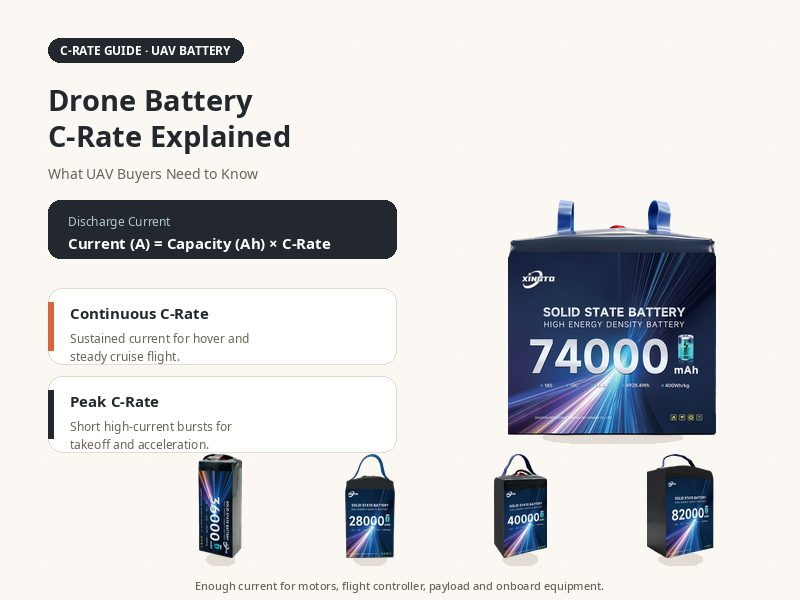
C-rate is a measurement used to describe the charging or discharging speed of a battery relative to its rated capacity.
In simple terms, it tells you how much current a battery can deliver compared with its capacity.
For example:
- 1C means a discharge current equal to the battery's rated capacity in amperes.
- 5C means a discharge current five times the rated capacity.
- 10C means a discharge current ten times the rated capacity.
- 20C means a discharge current twenty times the rated capacity.
A higher discharge C-rate generally means that a battery can deliver more current relative to its capacity, provided the battery is designed and rated for that operating condition.
For industrial drones, this is particularly important because different flight stages require different levels of electrical power.
During takeoff, rapid acceleration, heavy lifting, or sudden changes in flight conditions, the propulsion system may demand substantial current from the battery.
A battery with an insufficient discharge capability may not be suitable for these demanding operating conditions.
2. How to Calculate Drone Battery Discharge Current
Understanding the relationship between battery capacity and C-rate helps UAV manufacturers evaluate whether a battery can meet their power requirements.
The basic formula is:
\[ I = C \times Q \]
Where:
- \(I\) = Discharge current (A)
- \(C\) = Discharge rate (C)
- \(Q\) = Battery capacity (Ah)
For example, consider a drone battery with a rated capacity of 20Ah.
| Discharge Rate | Theoretical Discharge Current |
|---|---|
| 1C | 20A |
| 5C | 100A |
| 10C | 200A |
| 15C | 300A |
| 20C | 400A |
If a 20Ah battery is rated for 10C continuous discharge, its rated continuous discharge current would be 200A.
However, the actual usable current must also comply with the battery manufacturer's specifications and the limits of the BMS, connectors, cables, and other electrical components.
Practical Example
Suppose an industrial UAV uses a 20Ah battery and its propulsion system requires a high current during takeoff.
A 10C-rated battery has a theoretical continuous discharge capability of 200A, while a 5C-rated battery of the same capacity has a theoretical continuous capability of 100A.
If the UAV requires more than 100A under the specified operating conditions, the 5C battery may not meet the requirement.
The final battery selection should be based on the actual current demand of the UAV, including its maximum operating conditions and appropriate engineering margins.
3. Continuous Discharge Rate vs. Peak Discharge Rate
When comparing high C-rate drone batteries, it is important to distinguish between continuous discharge and peak discharge.
These two specifications describe different operating capabilities.
Continuous Discharge Rate
The continuous discharge rate refers to the current a battery is designed to deliver continuously under specified operating conditions.
It is particularly important for industrial drones that require sustained power during extended hovering, heavy lifting, or long-duration operations.
A suitable continuous discharge rating helps the battery support the UAV's normal power requirements without exceeding its operating limits.
Peak Discharge Rate
The peak discharge rate refers to a higher current that a battery can deliver for a limited period.
It may be relevant during:
- Drone takeoff and rapid climbing
- Sudden acceleration
- Heavy payload lifting
- Rapid changes in motor output
- Short periods of high propulsion demand
Peak discharge ratings must always be considered together with their permitted duration, temperature conditions, voltage limits, and recovery requirements.
A battery advertised with a high peak C-rate does not necessarily have the same continuous discharge capability.
| Specification | Continuous Discharge | Peak Discharge |
|---|---|---|
| Operating period | Sustained operation | Limited duration |
| Main purpose | Regular power demand | Short-term high power demand |
| Typical application | Hovering and sustained flight | Takeoff and acceleration |
| Selection priority | Very important | Important for demanding flight conditions |
When evaluating a drone battery, buyers should request both continuous and peak discharge specifications instead of comparing batteries using only one C-rate figure.
4. Why C-Rate Matters for Industrial UAVs
Industrial drones often operate under more demanding conditions than small recreational drones.
Their batteries may need to support larger propulsion systems, heavier payloads, specialized equipment, and frequent takeoff and landing cycles.
The appropriate C-rate can therefore influence several aspects of UAV operation.
4.1 Takeoff and Climbing Performance
Takeoff and climbing often require substantial power from the propulsion system.
A battery must be capable of delivering the required current without exceeding its rated limits.
If the discharge capability is insufficient, excessive voltage drop or battery protection activation may affect the UAV's operation.
4.2 Heavy Payload Applications
Agricultural spraying, firefighting, cargo transportation, and other industrial applications may require drones to carry substantial payloads.
As payload weight increases, propulsion demand may also increase.
A suitable high C-rate battery can help support the higher current requirements of the UAV, provided that the battery capacity, voltage, thermal design, and power system are properly matched.
4.3 Stable Power Delivery
Industrial UAVs rely on a stable electrical power supply for propulsion and onboard electronics.
Battery voltage may decrease under high-current discharge due to internal resistance and other operating factors.
Selecting a battery with an appropriate discharge capability can help reduce excessive voltage drop under the intended load.
4.4 Demanding Flight Conditions
Industrial drones may experience changing power requirements during takeoff, maneuvering, hovering, and landing.
A properly selected battery should support the expected current profile throughout the intended flight mission.
5. High C-Rate vs. High Energy Density Drone Batteries
High C-rate and high energy density are two different battery performance characteristics.
They are both important for industrial UAVs, but they address different requirements.
High energy density describes how much energy a battery stores relative to its weight or volume.
High C-rate describes how quickly a battery can deliver or receive current relative to its rated capacity.
A high-energy-density battery is often considered when longer flight endurance and reduced battery weight are priorities.
A high C-rate battery is considered when the UAV requires substantial current output for propulsion or payload operations.
| Comparison | High Energy Density Battery | High C-Rate Battery |
|---|---|---|
| Main characteristic | More energy relative to weight | Higher current relative to capacity |
| Primary objective | Support flight endurance | Support demanding power requirements |
| Important consideration | Energy-to-weight ratio | Continuous and peak current |
| Common application needs | Long-duration missions | High-power propulsion and heavy loads |
Some UAV applications require both high energy density and high discharge capability.
However, these characteristics involve different engineering considerations. A battery should be evaluated using its complete technical specifications rather than assuming that a higher energy density automatically means a higher discharge rate.
For more information, read our related guide:
Drone Battery Energy Density Guide: Understanding High Energy Density UAV Battery Technology
6. How to Choose the Right C-Rate for Your Drone
Choosing a suitable C-rate requires more than simply selecting the highest available number.
The battery must match the electrical requirements of the UAV and its intended operating conditions.
Here are five important factors to consider.
6.1 Calculate the UAV's Current Requirements
Start by understanding the current demand of the complete propulsion system.
Consider:
- Total motor current during takeoff
- Current during normal flight
- Maximum current under demanding conditions
- Payload weight
- Number and specifications of propulsion units
The battery's continuous discharge capability should be sufficient for the expected sustained current demand.
Its peak discharge capability should also accommodate short-duration current demands.
6.2 Consider Battery Capacity
Battery capacity and C-rate work together to determine the theoretical discharge current.
For example, a 10Ah battery rated at 20C has a theoretical discharge current of 200A.
A 20Ah battery rated at 10C also has a theoretical discharge current of 200A.
This illustrates why buyers should evaluate both capacity and discharge rate rather than comparing C-rate alone.
6.3 Evaluate Battery Weight and Energy Density
For UAVs, battery weight directly affects the total aircraft weight and payload capacity.
A battery with a suitable combination of capacity, discharge capability, and weight can help achieve a better balance between endurance and power output.
The best configuration depends on the aircraft design and mission requirements.
6.4 Check Thermal Performance
High-current discharge generates heat inside a battery.
Battery temperature can affect electrical performance, efficiency, service life, and safety.
When evaluating a high C-rate battery, consider:
- Operating temperature range
- Heat generation under load
- Thermal management design
- Permitted discharge conditions
- Temperature monitoring and protection
Actual temperature limits should be confirmed using the manufacturer's technical documentation.
6.5 Check the Complete Electrical System
The battery is only one part of the UAV power system.
The BMS, connectors, wiring, power distribution system, and electronic speed controllers must all support the required current.
A battery with a high rated discharge capability cannot compensate for undersized connectors, cables, or other electrical components.
7. C-Rate Requirements for Different Industrial Drone Applications
Different UAV applications have different power requirements. The appropriate battery discharge rate depends on aircraft design, payload, propulsion configuration, and flight mission.
The following table describes general selection considerations rather than fixed C-rate recommendations.
| UAV Application | Main Battery Considerations |
|---|---|
| Agricultural Spraying Drones | Sustained propulsion power, payload weight, and repeated flight operations |
| Heavy Lift Drones | High current demand, battery capacity, and thermal management |
| Firefighting Drones | Power requirements under demanding payload and operating conditions |
| Delivery Drones | Payload capacity, route requirements, and energy consumption |
| Mapping and Survey Drones | Flight endurance, battery weight, and stable power delivery |
| Inspection Drones | Mission duration, equipment load, and reliable power supply |
| FPV Drones | High instantaneous power demand and responsive propulsion |
For example, agricultural spraying drones and heavy-lift UAVs may place greater demands on their propulsion batteries than lightweight mapping platforms.
However, this does not mean every agricultural or heavy-lift drone requires the same C-rate.
The correct specification should be determined using the UAV's actual electrical load and the battery manufacturer's discharge ratings.
8. How Does a High C-Rate Affect Drone Battery Performance?
A high discharge capability can support demanding UAV power requirements, but it should not be considered an unlimited performance advantage.
Several factors need to be considered.
Advantages of an Appropriate High C-Rate Battery
- Supports higher current output relative to battery capacity.
- Helps meet demanding propulsion power requirements.
- Provides greater flexibility for high-power UAV designs.
- Can support short-duration high-current operating conditions when properly rated.
Important Engineering Considerations
- High-current discharge can increase heat generation.
- Excessive current can accelerate battery degradation.
- Voltage drop depends on internal resistance and operating conditions.
- Connectors and wiring must support the required current.
- Continuous and peak discharge limits must be respected.
A well-designed UAV battery should balance discharge capability, energy density, capacity, weight, thermal performance, and safety.
9. Xingto High C-Rate Drone Battery Solutions
Xingto focuses on industrial drone battery development and manufacturing, providing battery solutions for different UAV power requirements.
For industrial drone manufacturers and system integrators, battery selection involves more than choosing a capacity or discharge rate. The battery configuration must match the aircraft's propulsion system, available installation space, electrical interfaces, and intended mission.
Xingto supports customized industrial drone battery configurations based on project requirements.
Key Customization Options
Battery Capacity
Capacity can be selected according to the UAV's energy requirements, flight mission, and available installation space.
Voltage Configuration
Different series configurations can be evaluated according to the UAV power system, including 6S, 12S, 14S, 18S, 24S, and other configurations where supported by the product design.
Discharge Performance
Continuous and peak discharge requirements can be discussed during the battery selection and customization process.
Battery Dimensions and Connectors
Battery dimensions, connection interfaces, and wiring arrangements can be customized according to the UAV platform, subject to engineering feasibility.
Smart BMS Options
For projects requiring battery monitoring and protection, available BMS functions and communication protocols can be evaluated according to the system requirements.
Looking for a High C-Rate Drone Battery?
Whether you are developing an agricultural spraying drone, a heavy-lift UAV, or another industrial aircraft, selecting the right battery discharge capability is essential for reliable power delivery.
Contact Xingto to discuss your UAV battery requirements, including capacity, voltage, continuous discharge current, peak discharge current, dimensions, and connectors.
Our team can help evaluate a suitable customized battery configuration for your project.
10. Frequently Asked Questions About Drone Battery C-Rate
Q1. What does 10C mean on a drone battery?
A 10C rating means that the battery's rated discharge current is ten times its rated capacity expressed in ampere-hours. For example, a 10Ah battery rated at 10C has a theoretical discharge current of 100A, subject to the manufacturer's operating conditions and specifications.
Q2. Is a higher C-rate always better for drone batteries?
No. A higher C-rate is not automatically better. The battery should match the UAV's actual current requirements. Selecting an unnecessarily high discharge rating may add cost or involve design trade-offs without providing meaningful benefits for the application.
Q3. What is the difference between continuous and peak C-rate?
Continuous C-rate describes the discharge capability maintained under specified operating conditions. Peak C-rate describes a higher discharge capability permitted for a limited period. Always check the manufacturer's specified peak duration and operating conditions.
Q4. How do I calculate the discharge current of a drone battery?
Multiply the battery capacity in ampere-hours by its discharge C-rate.
For example, a 15Ah battery rated at 10C has a theoretical discharge current of 150A.
Q5. Does a high C-rate battery provide longer flight time?
Not necessarily. C-rate describes current capability, not stored energy. Flight time is influenced by battery capacity, energy density, aircraft weight, propulsion efficiency, payload, flight conditions, and power consumption.
Q6. Are high C-rate batteries suitable for agricultural drones?
They can be suitable for agricultural drones when the propulsion system requires high current, particularly under demanding payload and flight conditions. The appropriate battery should be selected according to the UAV's electrical load and manufacturer specifications.
Q7. Can a drone battery have both high energy density and high C-rate?
Yes, but achieving a suitable balance requires careful cell selection and battery pack engineering. Buyers should evaluate energy density, discharge capability, thermal performance, weight, and service life together.
Q8. Can Xingto customize high C-rate drone batteries?
Xingto provides industrial drone battery customization based on project requirements. Customization can include capacity, voltage configuration, dimensions, connectors, and other supported specifications. Continuous and peak discharge requirements should be confirmed during technical evaluation.
Conclusion
C-rate is an important specification when selecting a battery for an industrial drone. It helps determine how much current a battery can deliver relative to its rated capacity and whether it can support the UAV's propulsion and payload requirements.
However, the highest C-rate is not always the best choice. Battery capacity, energy density, weight, thermal performance, electrical connections, and actual flight conditions must all be considered.
For UAV manufacturers and industrial drone operators, selecting a battery with the right balance of energy and power is essential for developing a reliable drone power system.
Contact Xingto to discuss customized industrial drone battery solutions for your UAV project.