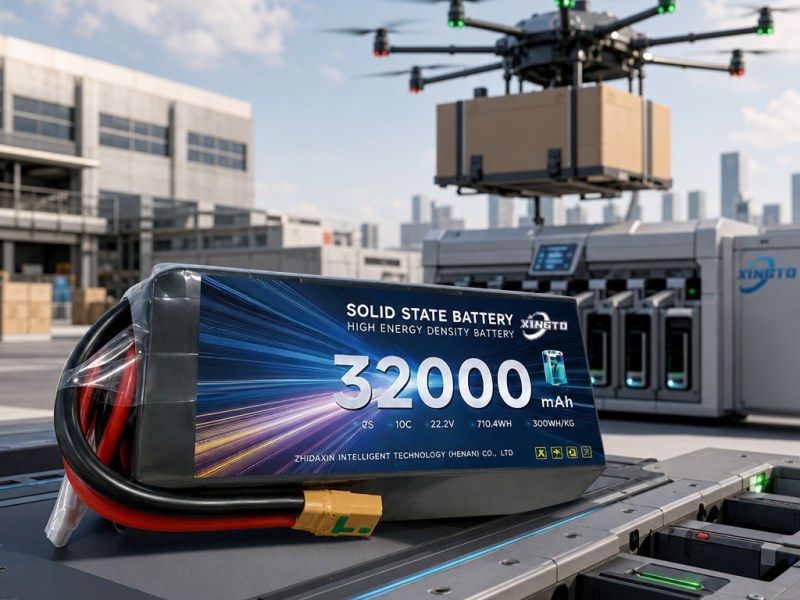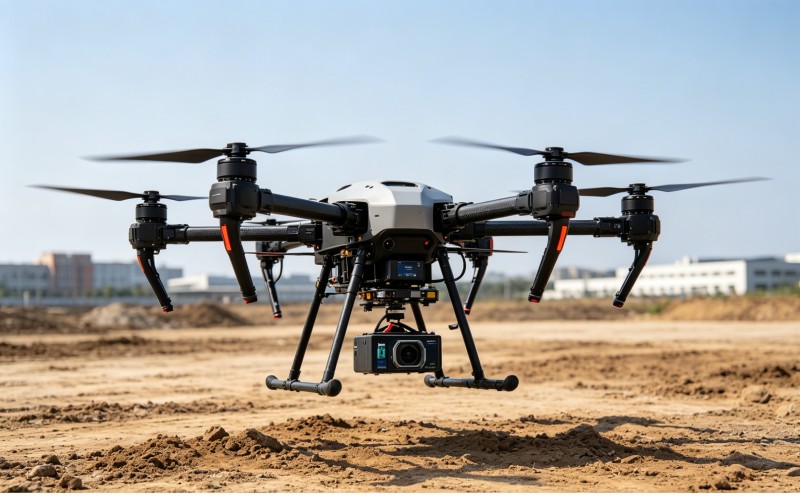

Battery performance is one of the key factors determining how long an industrial drone can fly, how much payload it can carry, and how efficiently it can complete its mission. As industrial UAV applications continue to expand, drone manufacturers and operators are paying increasing attention to battery energy density.
A high energy density drone battery can store more energy relative to its weight. This can help reduce the overall weight of a UAV power system while providing sufficient energy for demanding flight operations.
However, energy density is only one factor in battery selection. Discharge rate, battery voltage, capacity, thermal management, cycle life, and compatibility with the drone platform also matter.
This guide explains what drone battery energy density means, how it is measured, why it matters, and how to select the right high energy density UAV battery for different industrial applications.
What Is Drone Battery Energy Density?
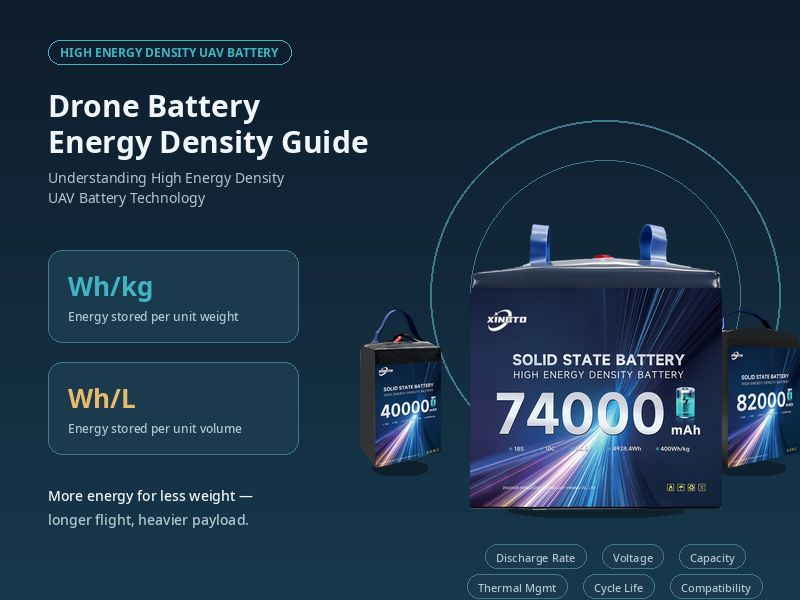
Battery energy density describes how much energy a battery can store relative to its weight or volume. For drone batteries, the most commonly discussed measurement is gravimetric energy density, expressed in watt-hours per kilogram (Wh/kg).
A higher Wh/kg value means a battery can theoretically store more energy without increasing its weight.
For example, when comparing two batteries with the same weight, the battery with higher energy density can provide more stored energy. This can be particularly useful for industrial drones that need longer flight endurance or must carry additional equipment.
There are two main ways to describe battery energy density:
Gravimetric Energy Density (Wh/kg)
Gravimetric energy density measures the amount of energy stored per unit of battery mass.
It is especially important for drones because total takeoff weight directly affects flight performance, payload capacity, and energy consumption.
Volumetric Energy Density (Wh/L)
Volumetric energy density measures the amount of energy stored per unit of battery volume.
It matters when the drone has limited space for battery installation. A battery with high volumetric energy density can provide more energy within a compact installation space.
For most industrial UAV battery selection projects, Wh/kg is an important starting point, while Wh/L helps determine whether the battery fits the aircraft's available space.
Why Does Energy Density Matter for Industrial Drone Batteries?
Industrial drones often operate under more demanding conditions than recreational drones. Agricultural spraying, surveying, inspection, firefighting, and logistics missions may require longer flight times, heavier payloads, or repeated operation.
Battery energy density can influence several aspects of drone performance.
1. Longer Potential Flight Endurance
A battery with higher energy density can store more energy at a comparable weight.
When the drone's motor system and flight conditions are properly matched, this additional stored energy may help extend flight endurance.
Actual flight time also depends on aircraft weight, motor efficiency, propeller design, payload, wind conditions, flight speed, and battery discharge characteristics.
2. Improved Payload Flexibility
Industrial UAVs frequently carry cameras, sensors, spraying equipment, delivery containers, or other mission-specific devices.
Reducing battery weight while maintaining the required energy capacity may leave more weight allowance for payload equipment.
However, the actual payload benefit must be evaluated against the drone's maximum takeoff weight and power requirements.
3. More Efficient Power System Design
A compact, lightweight battery can give drone manufacturers more flexibility when designing the aircraft's power system.
This is particularly relevant for multirotor UAVs, VTOL aircraft, and other platforms with strict weight and installation constraints.
4. Better Suitability for Specialized Missions
Different industrial applications have different power requirements.
For example:
- Agricultural spraying drones may need high discharge capability and sufficient energy for repeated spraying operations.
- Mapping drones may prioritize stable power supply and flight endurance.
- Inspection drones may require a balance between compact size, battery weight, and operating time.
- Heavy-payload drones need careful coordination between energy capacity, discharge rate, and maximum takeoff weight.
Energy density should therefore be considered together with the actual mission profile.
How Is Drone Battery Energy Density Calculated?
The basic calculation for gravimetric energy density is:
\[ \text{Energy Density (Wh/kg)} = \frac{\text{Battery Energy (Wh)}}{\text{Battery Weight (kg)}} \]
Battery energy can be estimated using nominal voltage and capacity:
\[ \text{Energy (Wh)} = \text{Voltage (V)} \times \text{Capacity (Ah)} \]
For example, consider a battery with a nominal voltage of 44.4V and a capacity of 20Ah.
Its nominal energy is:
\[ 44.4 \times 20 = 888\text{ Wh} \]
If the battery weighs 2.5kg, its gravimetric energy density is:
\[ 888 \div 2.5 = 355.2\text{ Wh/kg} \]
This example illustrates the calculation method. Actual product specifications should be calculated using the manufacturer's confirmed nominal voltage, capacity, and battery weight.
When comparing products, make sure the figures use the same measurement basis. Cell-level energy density and complete battery-pack energy density are not necessarily the same.
Common Energy Density Levels in Drone Batteries
Different drone battery technologies and product designs offer different energy density levels.
For industrial UAV buyers, it is important to compare verified battery-pack specifications rather than relying only on advertised maximum values.
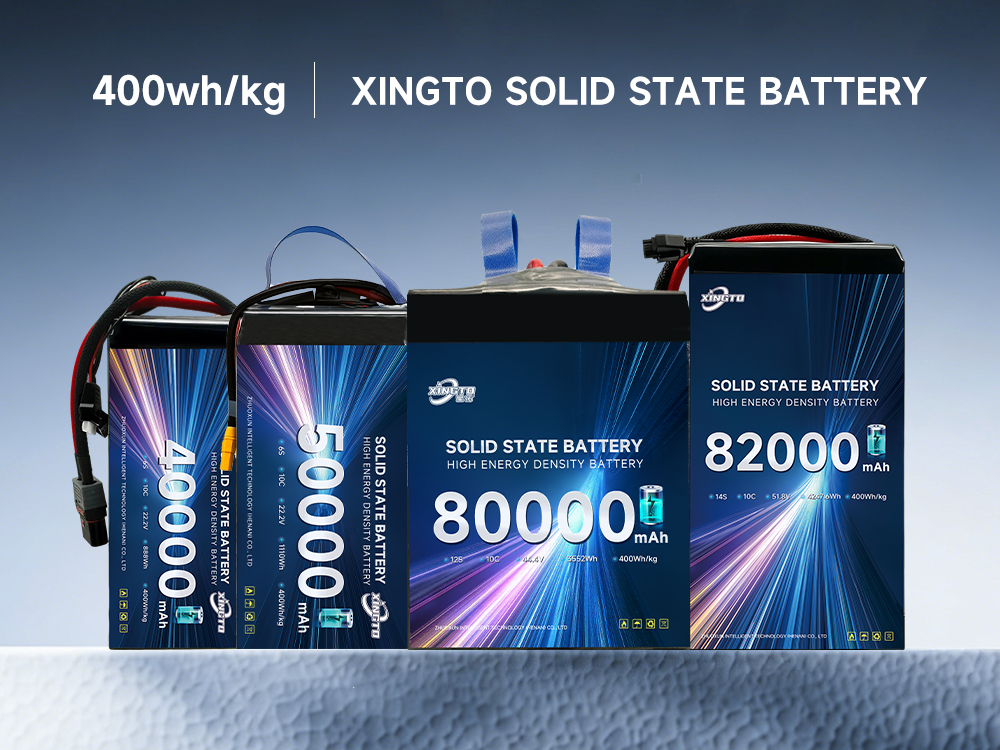
Xingto Battery provides industrial drone battery solutions across multiple energy-density categories, including 275Wh/kg, 300Wh/kg, 310Wh/kg, 320Wh/kg, 330Wh/kg, 340Wh/kg, 370Wh/kg, 400Wh/kg, and other customized specifications.
The availability of a particular energy-density level depends on the battery model and its verified technical specifications.
275Wh/kg Drone Battery
A 275Wh/kg battery can be considered for industrial UAV platforms that require a balance between battery weight, energy capacity, and overall power system compatibility.
The appropriate configuration depends on the drone's voltage, current requirements, installation dimensions, and mission duration.
300Wh/kg High Energy Density Drone Battery
A 300Wh/kg-class battery may be suitable for UAV manufacturers looking to improve energy storage within a limited weight budget.
It can be evaluated for agricultural, surveying, inspection, and other industrial drone platforms, subject to flight-system requirements.
320Wh/kg Drone Battery
A 320Wh/kg-class battery is an option for applications where weight reduction and energy capacity are both important.
When selecting this type of battery, buyers should also review discharge performance, operating conditions, and the battery pack's structural design.
340Wh/kg and 370Wh/kg Drone Batteries
Higher energy-density battery configurations may provide additional design flexibility for UAV platforms with strict weight limitations.
However, a higher Wh/kg value does not automatically mean that a battery is suitable for every drone. Discharge capability, safety design, and system compatibility must also be evaluated.
400Wh/kg and Higher Energy Density Solutions
Very high energy-density specifications attract attention in advanced UAV power system development.
When evaluating these products, buyers should distinguish between cell-level and complete-pack energy density, and request supporting test data and product documentation.
Do not compare different suppliers' advertised figures unless the test methods and calculation boundaries are consistent.
High Energy Density vs. High C-Rate: What Is the Difference?
Energy density and C-rate describe different battery characteristics.
Energy density indicates how much energy a battery can store relative to its weight or volume.
C-rate describes how quickly a battery can discharge or charge relative to its rated capacity.
For example, a battery designed for long endurance may prioritize energy storage, while an agricultural spraying drone may also require a high discharge rate to support demanding motor loads.
A suitable industrial drone battery needs to balance both characteristics according to the aircraft's power requirements.
| Battery characteristic | What it describes | Why it matters |
|---|---|---|
| Energy density | Energy stored per unit of weight or volume | Flight endurance and weight management |
| C-rate | Charging or discharging speed relative to capacity | Power output and load response |
| Capacity | Total electrical charge stored | Available energy when combined with voltage |
| Voltage | Electrical potential of the battery | Compatibility with the UAV power system |
| Cycle life | Number of charge and discharge cycles under defined conditions | Long-term operating cost |
For buyers, the best battery is not necessarily the one with the highest energy density or highest C-rate. It is the battery that meets the aircraft's complete power requirements.
How to Choose the Right High Energy Density Drone Battery
Selecting an industrial drone battery requires more than comparing Wh/kg values. The following factors should be considered before purchasing or customizing a battery pack.
1. Confirm the Required Voltage
The battery voltage must match the drone's power system.
Common industrial UAV battery configurations include 6S, 12S, 14S, 18S, 24S, and other customized series configurations.
The correct configuration depends on the motor system, electronic speed controllers, flight controller, and power architecture.
2. Determine the Required Capacity
Battery capacity is usually expressed in milliamp-hours (mAh) or amp-hours (Ah).
A higher capacity can provide more stored energy when voltage remains the same, but it may also increase battery weight and size.
The required capacity should be determined according to flight time targets, payload, power consumption, and available installation space.
3. Evaluate the Required Discharge Rate
The battery must be capable of supplying the current required by the drone during takeoff, hovering, acceleration, and other demanding flight conditions.
Choosing a battery with insufficient discharge capability may affect flight performance and battery operating temperature.
Buyers should provide the UAV's expected continuous and peak current requirements when requesting a customized battery.
4. Check Battery Dimensions and Weight
The battery must fit securely within the aircraft's battery compartment.
Its weight should also remain within the drone's maximum takeoff weight and center-of-gravity requirements.
A battery with high energy density is useful only when its physical dimensions, connectors, and electrical specifications are compatible with the aircraft.
5. Consider Battery Management and Protection
For industrial UAV applications, battery management is an important part of system reliability.
Depending on the battery design, a smart battery management system (BMS) may support functions such as voltage monitoring, temperature monitoring, current monitoring, and battery status communication.
Buyers should confirm the supported monitoring functions, communication protocol, and compatibility with the UAV system before ordering.
6. Request Technical Documentation
Before making a purchasing decision, ask the manufacturer for relevant product information, including:
- Nominal voltage and capacity
- Battery-pack weight and dimensions
- Energy density calculation basis
- Continuous and peak discharge current
- Charging specifications
- Operating temperature range
- Cycle-life test conditions
- Protection and monitoring functions
- Applicable test reports and certifications
These details help buyers make a more reliable comparison between different battery suppliers.
Applications of High Energy Density Industrial Drone Batteries
High energy density batteries can be considered for a wide range of industrial UAV applications.
Agricultural Spraying Drones
Agricultural drones need to carry spraying equipment and operate repeatedly across large areas.
Battery selection should consider payload weight, discharge rate, flight duration, charging arrangements, and the aircraft's battery replacement system.
Mapping and Surveying Drones
Mapping and surveying missions may involve extended flight paths and specialized imaging equipment.
A suitable battery should provide compatible voltage, stable power delivery, and sufficient energy for the planned mission.
Inspection Drones
Inspection drones are used for power lines, industrial facilities, bridges, and infrastructure.
Battery weight and capacity can influence mission planning, especially when the aircraft carries cameras, thermal imaging equipment, or other sensors.
Firefighting and Emergency Response Drones
Firefighting and emergency-response drones may operate in demanding environments and carry specialized equipment.
Battery selection should consider power demand, operating temperature limits, protection design, and the aircraft's emergency operating requirements.
Logistics and Heavy-Payload Drones
Logistics and heavy-payload UAVs require careful coordination between battery capacity, discharge performance, aircraft weight, and payload.
A customized battery solution can help match the power system to the aircraft's intended operating conditions.
Why Consider Semi-Solid-State Drone Batteries?
Battery technology continues to develop as UAV manufacturers seek improvements in energy density, weight, and operating performance.
Semi-solid-state battery technology is one direction being explored for advanced battery applications.
Compared with conventional liquid-electrolyte battery designs, semi-solid-state technologies use different electrolyte compositions and structural approaches. However, actual performance depends on the specific chemistry, cell design, manufacturing process, and battery-pack integration.
When evaluating a semi-solid-state drone battery, buyers should focus on verified product specifications rather than technology labels alone.
Important points include:
- Verified battery-pack energy density
- Weight and physical dimensions
- Discharge performance
- Thermal management and protection design
- Cycle-life test conditions
- Relevant safety and transportation documentation
For industrial UAV applications, the battery must be evaluated as a complete power system component, not only by its cell technology.
Xingto Battery: Industrial Drone Battery Solutions
Xingto Battery focuses on industrial drone battery solutions for UAV manufacturers, integrators, and professional drone operators.
Our product range covers different energy-density categories and battery configurations to support various industrial UAV power requirements.
Available customization options may include:
- Battery voltage and series configuration
- Battery capacity
- Battery dimensions and weight requirements
- Discharge-rate requirements
- Connectors and wiring
- Smart BMS and communication functions
- Battery pack structure and integration requirements
Our industrial drone battery solutions can be evaluated for agricultural spraying, mapping and surveying, inspection, firefighting, logistics, and other UAV applications.
For buyers developing a new UAV platform or upgrading an existing power system, providing the drone's electrical and mechanical requirements helps us recommend a more suitable battery configuration.
Frequently Asked Questions About Drone Battery Energy Density
What is a good energy density for a drone battery?
There is no single energy-density value suitable for every drone. The appropriate level depends on the aircraft's weight limit, flight-time target, payload, discharge requirements, and battery technology.
Buyers should compare verified complete-pack energy density rather than relying solely on cell-level figures.
Does higher energy density always mean longer drone flight time?
No. Higher energy density means more stored energy relative to battery weight, but actual flight time also depends on the drone's total weight, motor efficiency, propeller design, payload, weather, and flight conditions.
What is the difference between battery energy density and capacity?
Energy density measures stored energy relative to weight or volume, while capacity measures the amount of electrical charge a battery can store.
Battery voltage and capacity together determine nominal energy in watt-hours.
Is a high energy density battery suitable for agricultural drones?
It can be, provided the battery also meets the drone's voltage, capacity, discharge-rate, weight, and installation requirements.
Agricultural spraying drones often need to balance energy storage with high power output.
What information is needed to customize an industrial drone battery?
Manufacturers generally need the required voltage, capacity, continuous and peak current, target weight, battery dimensions, connector type, communication requirements, and intended application.
Providing the drone model or power system specifications can also help improve customization accuracy.
Can Xingto customize drone battery packs?
Xingto offers customization options for industrial drone battery applications. Available configurations depend on the required electrical specifications, mechanical dimensions, battery design, and project requirements.
Contact the team with your UAV power system parameters to discuss a suitable solution.
Contact Xingto for High Energy Density Drone Battery Solutions
Choosing the right drone battery requires a balance between energy density, discharge performance, weight, capacity, and system compatibility.
If you are developing an industrial UAV or looking for a customized battery pack, Xingto Battery can help evaluate your requirements and discuss suitable battery configurations.
Contact Xingto Battery to discuss your industrial drone battery project.